Essay Tech Governance
Technology Audits Before a Nonprofit Executive Director Transition
A pre-handover tech audit shields continuity and leaves choices to the new ED.
An executive director transition is a governance event, and a technology audit is how the board protects continuity, compliance, and institutional knowledge through the handover. The audit maps systems, access, costs, documentation, and technical debt before responsibility passes to new leadership. Its purpose is to give the incoming ED a clear diagnosis while leaving tool choices to them.
Why an executive director transition is a governance event, not just a personnel change
The board has more to do during a leadership change than choose a successor. Signing authority shifts, funder relationships are in flux, and grant deadlines do not pause while the search proceeds. Staff still need to know what to do and who can make decisions. The board’s readiness determines how much the organization loses during this compressed period of exposure.
A five-phase transition structure covers announcement, gap period, search, handover, and onboarding, but technology handover is often absent from transition templates. That omission leaves a gap in the board’s oversight. Written mandates for interim leadership spell out what someone can sign, whom they can hire, and what they can spend. They also need a technological counterpart defining which systems that person can access, change, or shut down, because transferring authority requires more than transferring an office key.
What the board is actually inheriting responsibility for when an ED leaves
Bank signatories, payroll approval, and check-signing limits are familiar transition concerns. They need to do the same for donor database administration, payment processors, cloud storage, and system credentials. Who controls those accounts when the ED leaves? A leader who leaves may be the only person, or the main person, with access to systems the organization relies on and owns.
Grant documentation systems, Form 990 records, and donor restrictions all leave digital footprints that people must still be able to understand after the handover. The outgoing ED may also be the only person who understands how linked tables, automations, and integrations fit together. Without documentation, the incoming ED’s first weeks can be spent reconstructing what the organization owns, delaying learning about what it does.
Incoming EDs in 2026 also need technological fluency to identify opportunities for automation, question vendors and data partners, and govern privacy, data ethics, and algorithmic risk. An undocumented environment obstructs that work from the outset. To judge what to do with systems, a leader needs to know what they are for, who owns them, and what they depend on. The board is therefore handing over not just accounts, but the conditions under which its next executive can exercise judgment.
Why most nonprofits arrive at a transition with a technology environment no one fully understands
This complexity usually grows out of choices that made sense under pressure. Early cloud migration promised cost savings, pandemic conditions forced rapid adoption of remote tools, and later consolidation and AI experimentation added another layer. Each phase brought in tools, while older ones sometimes stayed in use. A purchase that solved an immediate problem could therefore become part of an environment no one had designed as a whole.
Systems mostly work, but someone has to stitch disconnected data together by hand before staff can use it. In smaller organizations without a central IT function, no one may have explicit responsibility for reviewing redundancy or fit. Technical debt accumulates through those gaps in oversight even when staff work with care and ability.
When does this IT problem become a board concern? It can stay with the people who run the systems as long as someone understands the connections and keeps them working. Once that person leaves, however, the organization’s dependence on undocumented knowledge becomes a continuity risk. An audit is a normal corrective to that structural problem.
What a technology audit at an ED transition actually covers
A transition audit is broader than an IT security review and different from a procurement exercise. Its deliverable is a governance document showing what the organization owns, who controls it, what it costs, and where it is exposed. Access comes first because it underpins financial control. The review covers system logins, admin credentials, and two-factor authentication tied to the departing ED’s personal accounts or devices, with priority given to bank accounts, payment processors, payroll, and donor databases.
Cloud storage, email domain administration, and grant portals also belong in that review. They are easy to overlook during a financial handover. The system inventory then lists which subscriptions are still active, what they cost each year, which functions overlap, and what nonprofit pricing the organization may be missing. The compliance review checks which rules apply to the organization’s work, including which HIPAA obligations apply, what federal grant IT requirements call for, and how it handles donor data privacy.
Documentation needs a practical test. Could an interim or incoming ED operate the systems without calling the person who left? For applications, the handoff must support deployment, monitoring, support, restoration, and change without an undocumented favor from the outgoing team. That requires operating knowledge, vendor relationships, known risks, and decision authority alongside source code and passwords.
The technical debt register lists the workarounds it finds and ranks them. Spreadsheets that fill gaps between systems, data copied by hand over and over, and personal notes kept because shared systems cannot be trusted all show costs that keep coming back. No-code bases and automations belong in the same assessment when they support mission-critical work. For an organization checking its codebase before hiring an outside development team, this scope also spells out what the review must cover in code quality, integration dependencies, and the handoff package. The prioritized register supports decisions about which repairs to make and when.
A five-phase transition structure covers announcement, gap period, search, handover, and onboarding, but technology handover is often absent from transition templates.
The gap period is the right time to run the audit, and why the new ED's preferences don't change that
Between the departure announcement and the new ED’s first day, the board holds direct responsibility for continuity. Updating bank signatories, contacting major funders, and listing grant deadlines already belong in this window. Technology review belongs beside those governance tasks. Commissioning it as a board action also gives it a clear basis for examining systems across the organization rather than treating it as one staff member’s project.
The incoming ED may have good reason to want to review technology on their own. Would a completed audit intrude on that judgment? The distinction is between diagnosis and mandate. A gap-period audit records the inherited environment before the new leader’s preferences shape the assessment, while leaving that leader free to decide what to change and in what order.
Founder exits make this timing especially important because they combine a longer transition runway with a high risk of undocumented dependencies. The founder’s continuing role needs to be settled before the search opens. Digital access needs the same clarity. The audit must untangle which systems the founder may still be able to access after leaving, so that the formal transfer of authority has a matching boundary in the technology environment.
What the board needs to think through before commissioning the audit
Before hiring a reviewer, the board needs to agree on what the review will cover, who will do it, and how the findings will be used. Scope can range from a credentials-and-access review for a sudden vacancy to a full inventory, compliance review, and technical debt assessment with recommendations. Complexity and data risk should determine the depth. A housing program that handles HIPAA-adjacent data needs a different review from a small advocacy organization, and each should get a review that fits its needs.
Ownership means deciding who has the capacity to conduct the review. A staff member, interim ED, board member with technical experience, or external engineering partner may do the work. Internal knowledge is useful but may not include the depth needed to assess code quality or compliance risks. An external partner can bring fresh eyes and a deliverable the incoming ED trusts. For nonprofits, that partner also needs to understand limited budgets, staff working across roles, and mission-first decisions, so the findings fit the organization’s ability to act.
The output needs an agreed audience and purpose. A board-level summary of systems, costs, and risks is the minimum, while a technical roadmap adds what to fix, in what order, and at what cost. That roadmap can inform the incoming ED’s first 90-day plan. Findings should reach the new leader before the first 90-day review, with a brief decision-making process ready to put the report to use on redundancies and recoverable costs.
The no-code and data infrastructure question the transition tends to surface
An undocumented Airtable base can turn a routine leadership change into an infrastructure decision. The person who built its automations may be the only one who understands their connections. Scale can expose constraints as well as knowledge gaps. Airtable’s free tier limits bases to 1,000 rows, while Team at $20/user/month is required for Gantt views, timeline views, and advanced scripting.
When the audit uncovers that dependence, the board has three paths. It can document and retain the system, migrate to a more sustainable alternative, or engage a partner to rebuild it on a solid foundation. None follows automatically from the discovery of poor documentation. The right choice depends on the organization’s data type, technical capacity, and hosting requirements.
NocoDB is a source-available Airtable replica with a mature codebase and active community. NocoDB, offered under a Sustainable Use License outside approved open-source licensing, specifically fits a need for an interface over an existing SQL database or a requirement to self-host for data residency. Baserow, by contrast, is purpose-built to look and feel like Airtable and is approachable for non-technical users. It has a permissively licensed open-source core, premium and enterprise features under separate licenses, a cloud free tier, and Premium at $10/user/month, billed annually.
Grist suits calculation-heavy and sensitive data, with Apache 2.0 open-source licensing and Pro at $8/user/month with annual billing. Notion serves a different kind of workload. It combines documents, wikis, and databases in a flexible, block-based workspace with lightweight task management. That makes it a good fit for wikis, project plans, and lightweight databases, but less of a fit for heavy relational data.
Smartsheet fits spreadsheet-oriented project, program, and portfolio management, including reports and governance, starting at $9/member/month, billed annually. SeaTable addresses organizations with GDPR requirements through a provider based in Mainz and servers in Germany, and it can also run on an organization’s own servers. Hosting is not a secondary concern for regulated data. For donor PII, background-check results, and restricted-fund ledgers, data residency and self-hosting capability should take priority over feature parity with Airtable in selection. The audit supplies the context for that choice without prescribing a replacement.
What skipping the audit actually costs — and why the objection about transition expense doesn't hold
A transition already places visible demands on the budget. Recruitment, interim leadership, overlap, and onboarding arrive as identifiable expenses, so another commissioned review can feel difficult to justify. Skipping the audit postpones its underlying work until the incoming ED must reconstruct access and system logic while taking on the rest of the role.
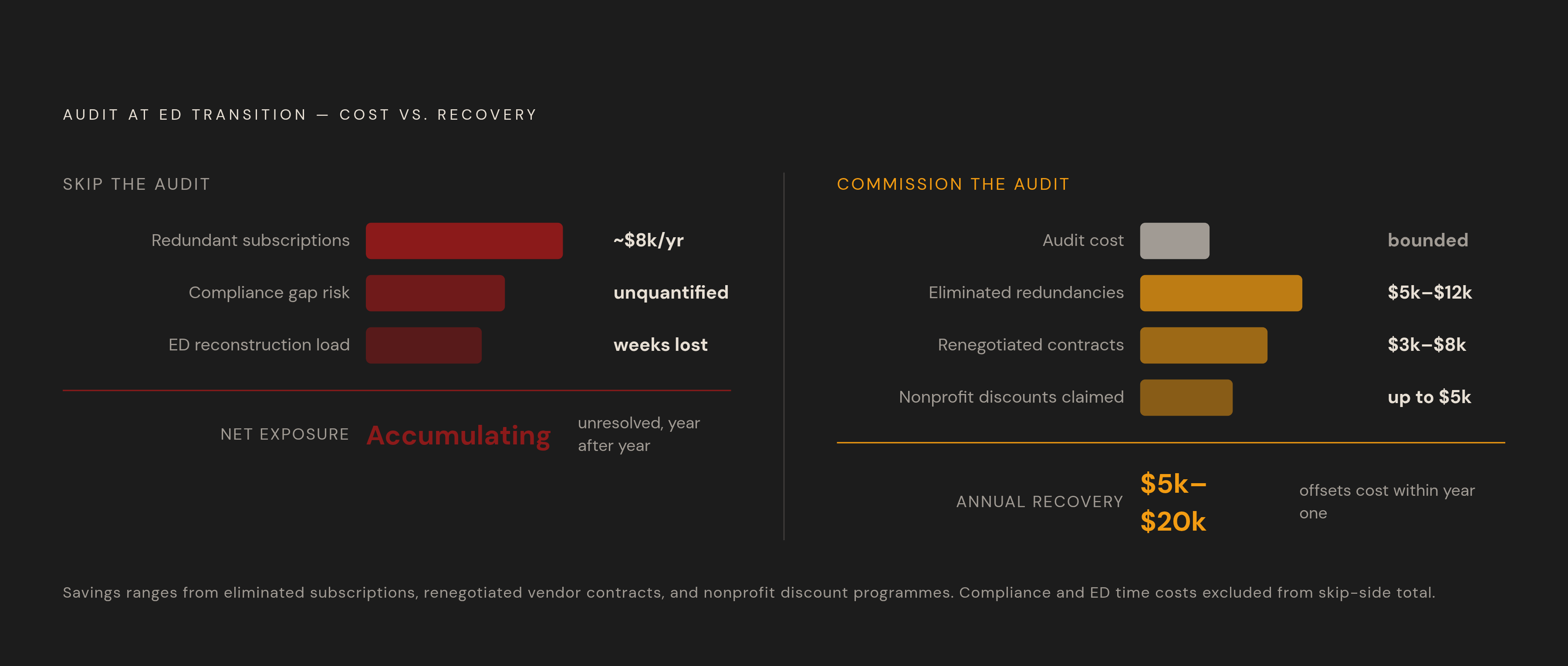
The postponed costs can also accumulate beyond leadership time. Redundant subscriptions may run for another year, while a funder audit may identify compliance gaps missed by internal review. Those gaps can involve federal grant IT requirements, the documentation needed for Form 990, and how HIPAA-adjacent data is handled. The distinction is not between spending and saving, but between a bounded review and unresolved costs that continue into the next administration.
There is a direct budget case as well. A typical audit surfaces $5,000–$20,000 in annual savings through eliminated redundancies, renegotiated contracts, and unclaimed nonprofit discount programs, typically offsetting its direct cost within the first year of new leadership. That does not make savings its sole purpose. The board’s duty during the gap period is to hand over a documented, understood organization, and a technology audit fulfills the digital part of that duty. Commissioning one is an act of sound governance.
Notes
- Proactive Steps to Navigate Nonprofit Leadership Changes - Lumsden CPA
Supplied the governance framing of leadership transitions, including bank signatories, funder contacts, grant deadlines and the board's responsibilities during the gap period.