
Essay Tech Governance
How Nonprofits Should Prioritize Technical Debt Findings Before Bringing in an Engineering Partner
A scored debt register helps nonprofits fix mission risks first.
Before hiring an engineering partner, a nonprofit should review its technical debt and rank what it finds by mission impact, security exposure, and how hard it will be to repair. The output should be a scored register that separates threats to program delivery, stakeholder data, and compliance from internal inconveniences. That preparation lets a partner validate the risks and scope the right work, rather than spend the engagement fixing whichever problem attracts the most complaints.
Why nonprofits accumulate technical debt faster than they recognize it
A delayed upgrade can be a reasonable decision when the alternative is cutting program work. Tight budgets leave little to spend on infrastructure, and short-term funding cycles make it hard to keep technology projects going for years. A grant period can end before a system is stable. Under those conditions, “it still works” becomes a practical reason to defer maintenance. The debt starts with choices that each make sense but cost more when they add up.
The full picture is harder to see. When staff wear several hats, no one may own the record of what each system does or depends on. Legacy systems become more expensive to upgrade as earlier upgrades are deferred, yet that growing obligation may never appear in a program budget. A prototype that works may become a tool staff depend on before anyone checks the scaffolding beneath it.
What technical debt actually costs a nonprofit when it goes unmanaged
The first cost is often lost staff capacity. Slow systems, broken integrations, and manual workarounds consume time that could support programs. These soft costs can exceed the visible maintenance bill because they recur across ordinary working days. As systems become harder to change, the cost also reaches future work. New features take longer, programs launch late, and grants can become harder to apply for.
Donor data, beneficiary records, and grant-linked financial data are valuable targets, and an unpatched system can provide an entry point. The exposure may sit outside the main database, in a kiosk, warehouse scanner, or field tablet that staff think of as equipment. A donor-data breach then creates more than a repair bill. Recovery disrupts operations, while regulatory exposure and lost trust can weaken fundraising capacity.
Compliance makes this more than a maintenance concern. For work governed by HIPAA, GDPR, or federal grant requirements, a no-code platform or AI-generated tool does not satisfy the nonprofit’s obligations on its behalf. As a program grows, so does the potential liability attached to those tools. Compliance debt therefore belongs at the top of the priority stack, even when the system appears to work.
Why bringing in an engineering partner before triaging debt produces the wrong engagement
Consider an engagement driven by complaints about reporting speed. Staff can describe the delay, demonstrate it, and explain how irritating it is, so faster reports become the project’s central goal. Meanwhile, a gap in backups of donor data stays outside the scope because it has not disrupted anyone’s day. The grant money or time under the contract runs out while the underlying risk remains.
That is the failure triage is meant to prevent. Surface-level assessment favors problems that are easy to demonstrate and quantify, while staff may have quietly routed around mission-critical failures for months. A partner needs that organizational context to weigh findings correctly. Its role is to validate, deepen, and execute against the nonprofit’s priorities.
The triage lens that separates mission-blocking debt from staff-friction debt
Does this finding prevent the organization from delivering programs, protecting stakeholders, or meeting compliance requirements, or does it make staff work harder? Unreliable grant reports, payment-processing errors, beneficiary portals going down, and damaged donor-data integrity are all mission-blocking debt. A slow internal dashboard or a copy-paste workaround is usually staff friction. The distinction rests on the consequence.
Staff friction is often temporarily absorbable. Mission-blocking debt has an external victim, such as a beneficiary unable to access a service or a funder receiving unreliable information. Security vulnerabilities form a third category because they may cause no visible disruption today while exposing the organization to a mission-blocking event. They should be treated as mission-critical before something breaks. Debt that touches regulated data flows should have the same priority from the start, before an incident shows why it matters.
How should nonprofits assess technical debt before the first partner call? A four-step process
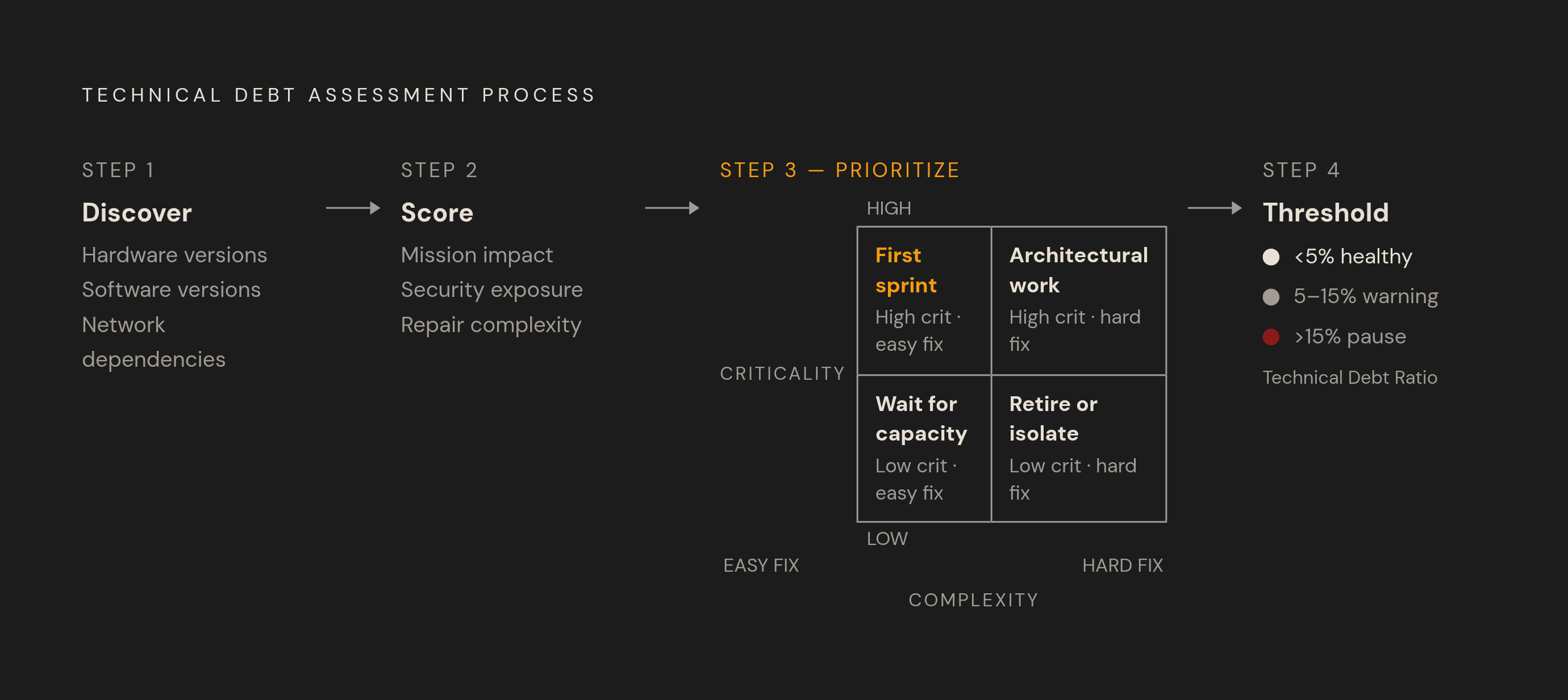
**Step 1. Use automated or assisted discovery to record hardware versions, software versions, and dependencies, including devices and applications connected to the network. Dependencies reveal where one failure can cascade into another. A team without IT staff can ask a part-time IT consultant or managed service provider to produce this bounded inventory, without committing to a full development engagement.
Step 2. Score each finding by its mission impact and security exposure. The working deliverable is a scored register, with each finding connected to the affected system, its mission consequence, its security or compliance exposure, and its repair complexity. Put vulnerabilities affecting donor data and beneficiary records, together with compliance-critical gaps, at the top, followed by program-delivery blockers and then internal inefficiencies. Technical size is not the deciding factor. Legacy code that no program depends on may rank below frequently changing code around which an active program is evolving, even if the legacy code looks worse in an audit.
Step 3. Compare mission criticality with remediation complexity. Findings with high criticality that are easy to fix belong in the partner’s first sprint, while high-criticality findings that are hard to fix should anchor the engagement’s architectural work. Low-criticality repairs that are easy to make can wait until staff have time. For low-criticality problems that are hard to fix, retiring or isolating the system may be better than paying for costly repairs. Where a system must remain in use while replacement is planned, network segmentation and restricted access can reduce risk, but should not be mistaken for eliminating it.
Step 4. Establish a Technical Debt Ratio threshold. Use the ratio to set expectations for stabilization versus feature delivery while preserving the mission ranking. The triage bands are under five percent for a healthy codebase, five to fifteen percent for a warning zone, and above fifteen percent for a codebase that typically needs feature work paused for stabilization. These bands help frame the first engagement. The nonprofit should enter the conversation knowing whether it is asking a partner to build new capabilities or first make existing ones reliable.
When staff wear several hats, no one may own the record of what each system does or depends on.
How the triage output shapes a more productive partner engagement
The nonprofit arrives with non-negotiable risks, strategic investments, and work that can wait, so discovery starts from mission needs. A technical review can still change the planned order of work or uncover dependencies the nonprofit missed in its own assessment. The test is whether the partner understands the program context before challenging the priorities. Pushback based only on technical elegance is not the same as evidence that a different sequence better protects delivery.
Before committing to a full build, ask for paid discovery that reviews requirements against the triage findings. A properly scoped discovery for a mid-size project runs a few weeks and should include an assessment of the existing architecture. Ask for an architecture walkthrough from a comparable project as well. How the partner explains earlier decisions reveals whether it can connect technical judgment to organizational constraints. A partner that will look through the existing system before proposing a build offers more to go on than a polished case study alone.
Ask how AI-assisted code is reviewed before it merges, particularly if the current system already contains unreviewed generated code. Verify that source code, documentation, credentials, domains, and third-party accounts transfer to the nonprofit, without license-back clauses or agency-owned libraries that cannot be extracted. Who owns what should be clear before the contract is signed. An ongoing maintenance relationship can then preserve the value of the assessment instead of forcing the organization to reconstruct its technical history at every handoff.
Platforms that become their own technical debt — when Airtable is the problem, not the solution
A platform can be useful early and restrictive later. Airtable can serve as an MVP tool and an early operational database, but expanding programs may need custom logic, integrations, compliance arrangements, or control over data that the current setup cannot provide. Triage assesses whether the debt lies in the configuration or in remaining on the platform. Those diagnoses imply different scopes of work. Repairing integrations is not enough if the underlying platform cannot support the mission use case.
For a nonprofit whose complexity centers on donor management, volunteer coordination, and program tracking, Salesforce Nonprofit Cloud is an option to consider. Nonprofits that qualify can get ten free Nonprofit Cloud licenses through the Power of Us program. That does not make it the default replacement. A donor-centered system answers a different need from flexible internal data management, so the register should identify which problem the organization is actually trying to solve.
Technical capacity changes the options available to the organization. NocoDB and Baserow offer free community editions that can be self-hosted, with spreadsheet-style interfaces for working with structured data. NocoDB’s documentation names PostgreSQL and MySQL as primary external data sources, while Baserow is backed by PostgreSQL. NocoDB, Baserow, and Grist support self-hosting, which is relevant when server control is part of a compliance or data-residency requirement. The nonprofit still has to meet its compliance obligations even with that control.
Notion fits knowledge management and documentation combined with lightweight project tracking, while ClickUp and Smartsheet serve project execution and work-management workflows. These belong to different categories. The triage output should identify the workflow, ownership requirement, and compliance constraint that a replacement must satisfy. That gives a partner a reasoned migration brief rather than an invitation to choose from feature lists.
Making the case internally to act before the crisis arrives
Boards and executive directors can struggle to connect technical debt to the mission when its effects appear only as maintenance requests. The case becomes clearer when security is framed as donor stewardship, federal grant compliance as grant protection, and reduced workaround time as staff capacity. These are the organizational consequences the triage has already identified.
Grassi’s 2025–26 Nonprofit Leadership Report describes nonprofits prioritizing core systems and foundational capabilities, while noting that advanced safeguards are not consistently in place. That provides context for a board that sees maintenance as an unusual diversion from program work. The internal request still needs to be specific. A roadmap built from the register should show the current state, prioritized findings, proposed repair sequence, and estimated resource needs. Leadership can then consider a governed investment plan.
The same precision strengthens a capacity-building grant application. “Cybersecurity assessment and remediation” describes a clearer purpose than “IT expenses,” especially when it connects to program delivery and includes a plan for maintenance after the grant ends. The nonprofit can begin that work before hiring an engineering partner. Its prioritized inventory gives leadership a concrete decision, funders a defined need, and the eventual partner a scope grounded in the mission.
Notes
- How to Prioritize and Sell Technical Debt Remediation
Informed the approach of ranking technical debt by business impact and framing remediation as a case leadership can approve.